Who Stole My Room of One’s Own?
Kasia Derwinska
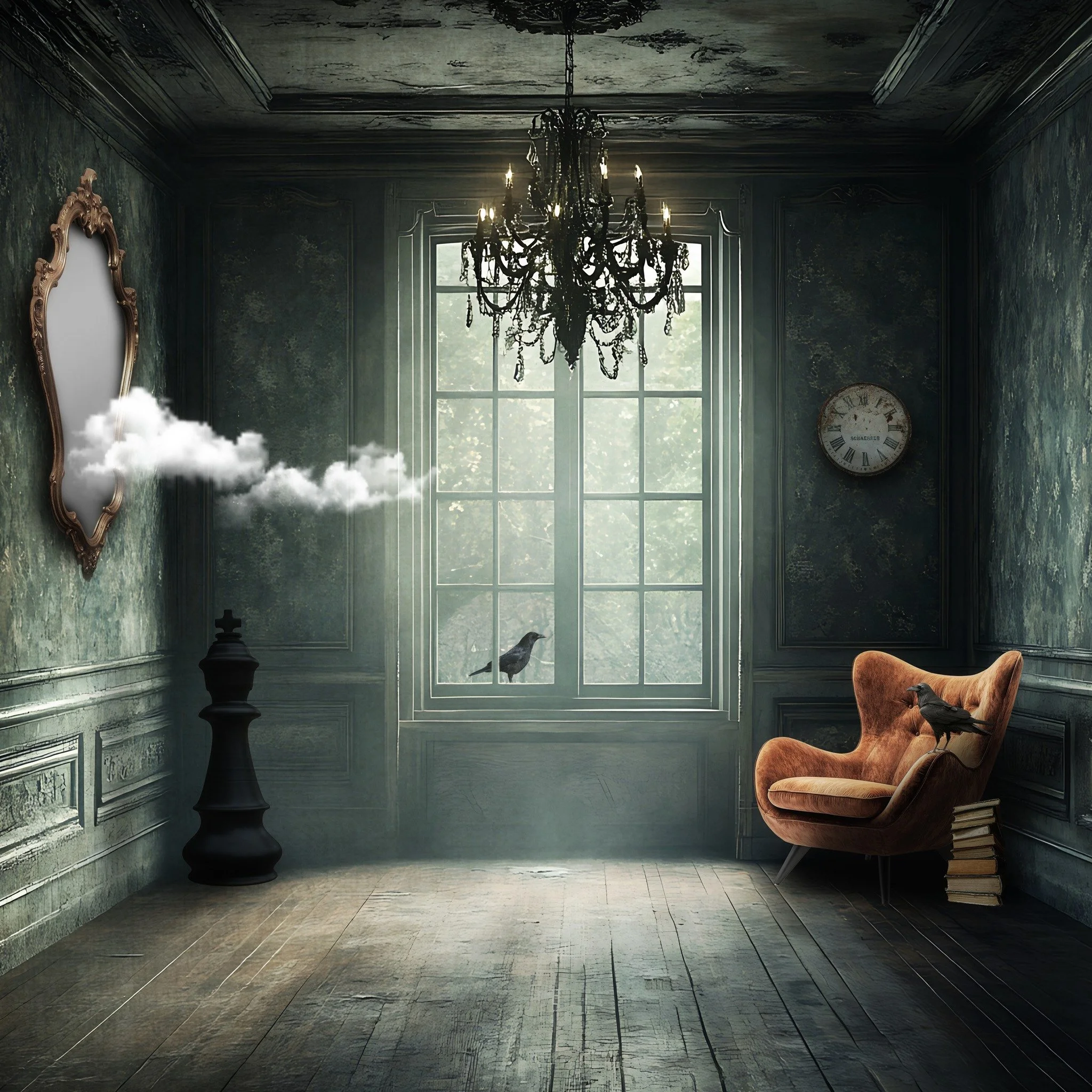
The blending of old and new works well in this image. It is fairly typical of Kasia’s work in that it is rich in deliberate symbolism that communicates a message about a snapshot of either a situation or an emotional process. The title of the image, ‘Who Stole My Room of One’s Own?’ demands an answer.
We have an obvious reference to the essay written by Virginia Woolf, who asserted that women must have money and space to write. She was referring to writing fiction, but over time, its meaning has evolved to relay something important to women across all artistic disciplines. It serves as a reminder that if basic conditions aren’t met, creativity will not flow. So, the title tells us that not only is something of fundamental importance missing, but it’s also been taken.
You can see it was a much-loved room. It isn’t palatial, but the solid wood floors, the wall panelling, the ornate mirror, and the chandelier all suggest it was once a space where time and money were invested. Despite the window taking up a lot of space and allowing light to enter the room, it isn’t what the eye falls on. As soon as we acknowledge the window, we see the crow sitting outside and the huge, elaborate chandelier hanging down from the ceiling. The chair looks warm, which could partly be attributed to its burnt orange colour, or maybe it’s the soft padding and rounded edges. The placement of the pile of books next to the chair seems appropriately positioned. And yet, they look as worn as the floor and the walls of the room; they also stand out in stark contrast to the chair, which looks newer and clean enough to sit on.
The clouds drifting out of the fogged-up mirror could suggest a lack of clarity. Is there uncertainty with the sense of self? Is someone not seeing themselves clearly enough? Are the clouds representative of ideas? They’re beautifully white, so they’re not carrying anything stormy. Are they a bridge between the conscious and unconscious mind? Do they exist to obscure the vision, or will they disperse to reveal a previously hidden truth? The mirror suggests something around the concept of one’s identity, but there is no clarity on its surface. It’s not reflecting anything in the room because it contains some sort of mist. The mirror itself looks old but solid. Is something clouding self-reflection? It’s telling me that the truth can’t be clearly seen — something is obstructing the normal process. But clouds can also represent divine forces, and sometimes, when the sun is too bright, we can welcome the occasional cloud to provide temporary respite from the heat and glare.
The king chess piece standing in the shadows in the corner makes me feel a little uneasy. He seems out of place because there is no board, no other pieces to protect him. It’s like he doesn’t know the game isn’t even being played anymore. Symbolically, he can represent leadership, sovereign authority, and the weight of responsibility. He’s the most important piece of the set, and yet is reliant on the protection of others and is limited in his movement across the board. His position in the corner could be symbolic of having been backed into it or placed there for punishment. It’s a position that indicates vulnerability in the later stages of a game. But there’s no game here — just him in the corner of an almost empty and decaying room. What does a king without a kingdom even represent? Did he steal the room of one’s own? Or is he the central character in the image? Is it his room that’s been stolen? Either way, within the image, he is stripped of context, and that means his actual purpose is questionable.
The pair of crows is interesting because we have one outside the window and one sitting on the arm of the chair that appears to be looking directly between the king and the mirror. Is the one outside the window acting as a watchman? Outside the window, we can see there is a light haze with trees in the background, which really helps to anchor the room as symbolising a real place. Are the birds acting as messengers from the subconscious? Or are they here to talk about transformation and change? Crows are smart birds, and as such, they can represent intelligence. Some people see birds as a bridge between the spiritual realms and physical reality, which can also be represented by the presence of the mirror and by the clouds.
The chandelier that hangs down into the middle of the picture is incredibly decorative. It appears both fragile and enduring at the same time. The lights are on, and it is interesting that we have light from not one, but two sources. It’s daylight outside, and the window is enormous and more than adequate at brightening the room. The lights on the chandelier may indicate a conscious effort to bring illumination to a situation — that switch didn’t flip itself. Daylight indicates a more natural source, but it is also dependent on the cycle of night and day. Having both types of light included in the same image is really interesting. It suggests two different sources of illumination to rely on, and we have the two crows, one inside, one outside. The chandelier is clearly a functional light, but its grandeur suggests a sense of luxury and wealth; it’s not a simple light bulb dangling down without a shade.
The old clock dominates the top right-hand corner, but its hands are missing. There’s an explicit message that whatever is going on in the room, it is not constrained by linear time. Order and logic are not the judge and jury here. We are looking at something that is timeless, and there is a certain calm that comes from not having to watch the clock. Although it does still suggest there’s something cyclical, even if the hands aren’t visible. Maybe there’s a hidden reference to the so-called invisible hands of time? Whatever the case, we’ve no way of knowing whether the mechanism on the inside is still present and working. Knowing some of Kasia’s other work, I am aware she has created an entire series called ‘In Search of Lost Time’, so the clock may also be a reference to time that has been lost.
We finally arrive at the comfy-looking chair, and that stack of old books beside it suggests wisdom has already been accrued more than it suggests learning that is still to be done. The chair is well-positioned to receive the natural light from the window, which is meaningful because that could be interpreted as trusting something from outside of the self to bring light to a situation. Perhaps it’s saying to trust natural cycles over man-made linear time-keeping. Is the crow that sits outside waiting to be let in to bring a significant message? The crow perched on the armchair is ideally positioned to analyse the relationship between the mirror and the king. Is he asking that the accrued wisdom be used to analyse what is seen?
Who Stole My Room of One’s Own? Who indeed. There are more than a few relevant interpretations here — the significant part being that someone has temporarily interrupted the creative output of someone with a well-established creative process. I say temporarily because although the paint on the ceiling and the walls is peeling and in need of repair, the room can soon be brought back to life. The damage is only superficial, but it will take time, effort, and probably money to repair. Was it the king? Did the crows stand guard while the king gained unlawful entry? Or was it some other external authority represented by the clock? As an observer, there is no way to know for sure. What I can see for sure is that the picture offers hope. The wisdom from the books is close at hand. More than enough light is coming through the window, and we have the backup chandelier if night should fall before we finish reading. There is no sign of the clock ticking — time will be the instrument and not the enemy.
Link to Kasia’s work (Facebook)
Other links:
Recent Posts












Categories
Tags
- Bird 10
- Water 6
- Rock 5
- Endings 4
- Window 4
- Boat 3
- Bones 3
- Clouds 3
- Art as Therapy 2
- Bandages 2
- Cards 2
- Chessboard 2
- Death 2
- Kraken 2
- Mask 2
- Puddles 2
- Rain 2
- Umbrella 2
- Veil 2
- Balloon 1
- Bed 1
- Birdcage 1
- Blindfold 1
- Books 1
- Box 1
- Bridge 1
- Bubble 1
- Buddha 1
- Caught 1
- Chair 1
- Chess 1
- Clock 1
- Cobwebs 1
- Cogs 1
- Cone Head 1
- Crown 1
- Desert 1
- Dice 1
- Distance 1
- Dreamcatcher 1
- Dreams 1
- Egg 1
- Face 1
- Fly 1
- Gramophone 1
- Grief 1
- Hair 1
- Halo 1
- Hammer 1
- Hollow Man 1

I was visiting one of my daughters the other day, and she mentioned she’d been gifted a book, and she’d had to put it down because she was at the point of flinging it off the balcony.
“It could just be me, though, mum. You might like it, and I’m maybe just being a dick. I don’t think he knows what he’s on about, and I ain’t getting some of the art.”
As she handed it over, I could see that I quite liked the art style. It was close enough to imagery that I knew I’d enjoy looking at, but I was concerned about the writing. Daughter hadn’t even got a quarter of the way through the book before her irritation had risen high enough to reject the entire thing.