Grim Tales Tarot
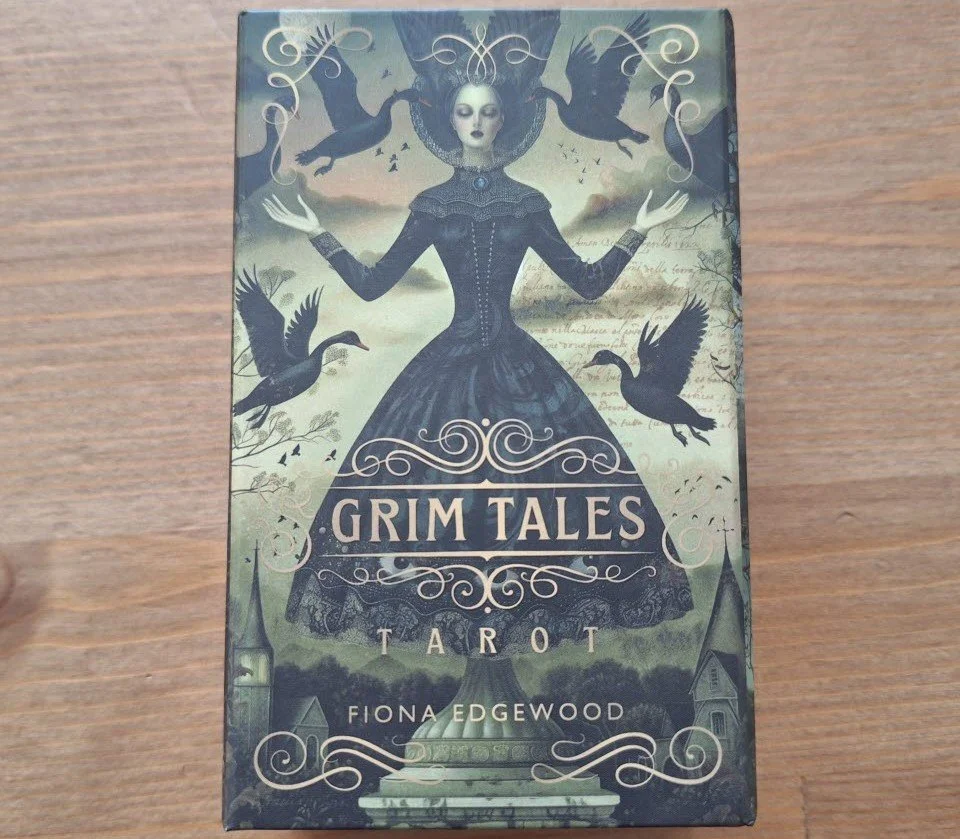
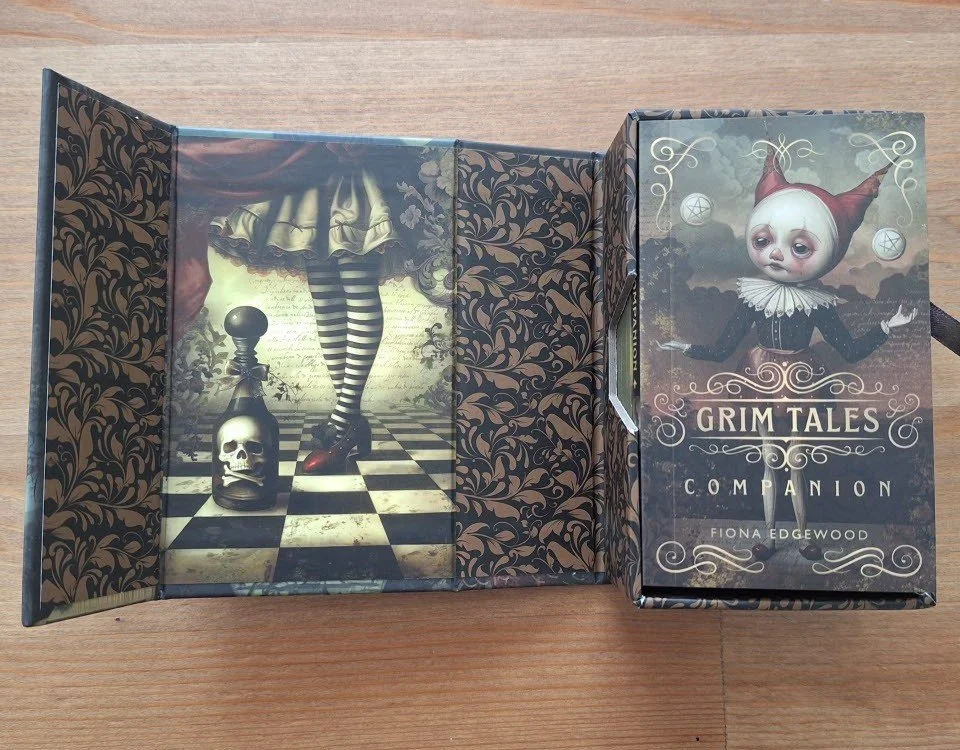
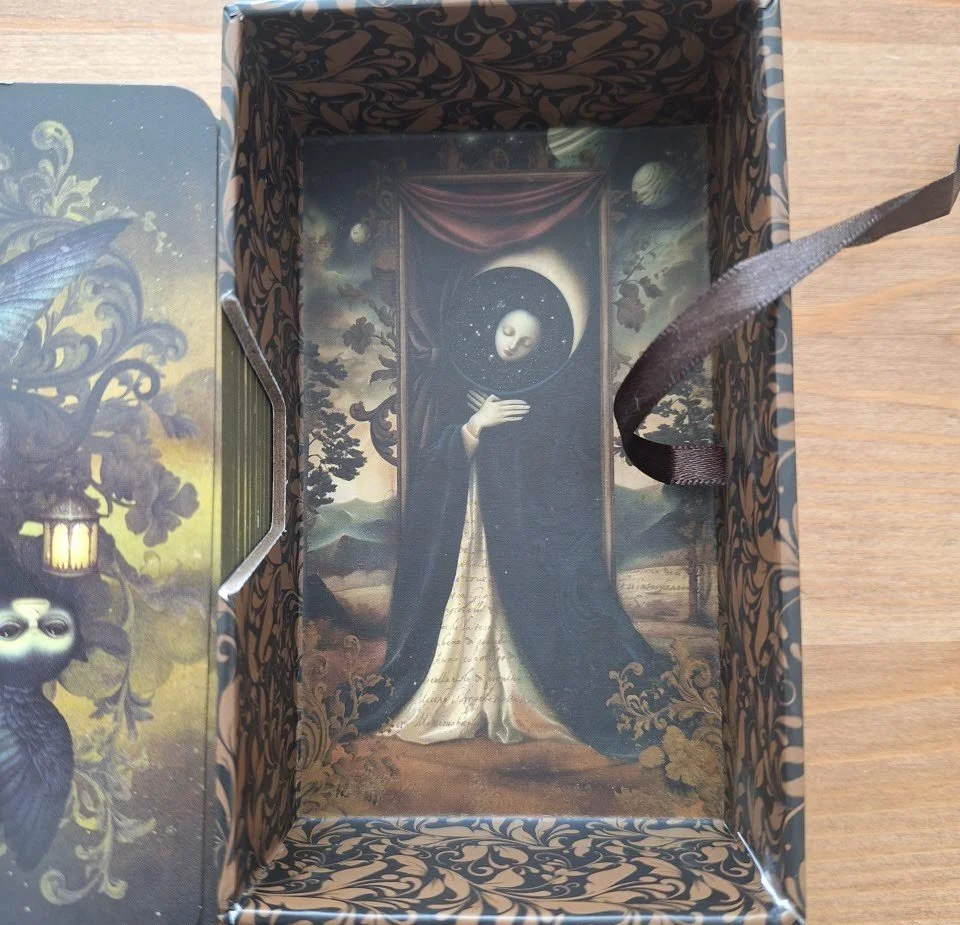
The Grim Tales Tarot is a relatively new release from late 2025 by Fiona Edgewood. I’ve got to be honest, I like the theme of the deck, and at first glance I like the artwork. I don’t usually check reviews before buying, but when I went to Google for the release date, I noticed ‘AI’ at the end of the deck name — I’ll look at this towards the end of the post. The cards come in a sturdy decorative box, and a small guidebook is included. The cardstock is pretty thin, but it’s not necessarily something that would put me off. The cards are not overly laminated, and they’re finished with a matte brown edging. The guidebook introduction explains that the biggest inspiration came from a collection of stories by the Brothers Grimm, but the card depictions aren’t necessarily related to any particular story. This post is more of a quick run-through than a thorough analysis of specific cards, mainly because I’m short on time and have a very long list of decks to get through in the coming weeks.
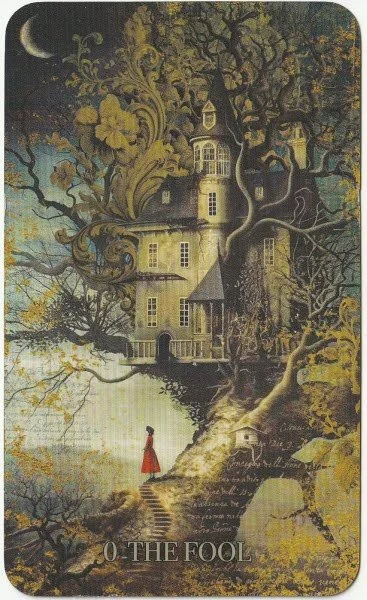
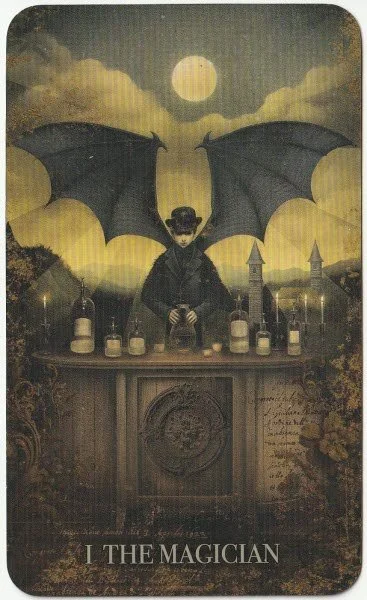
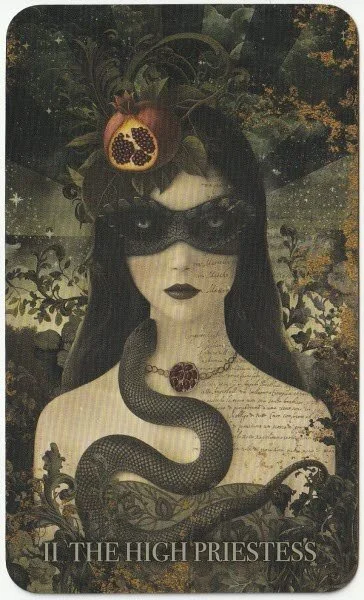
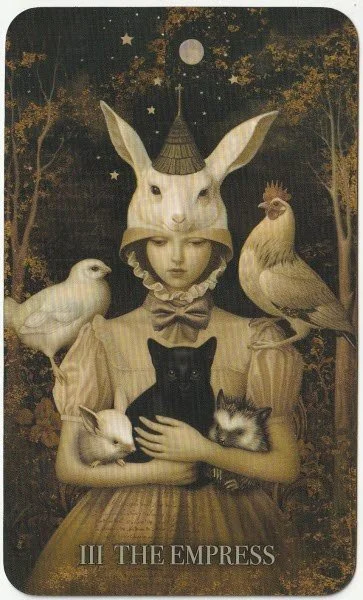
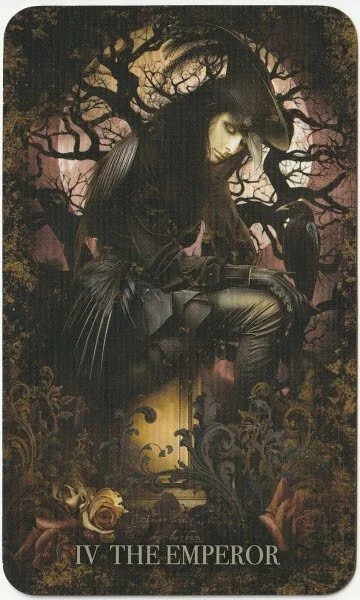
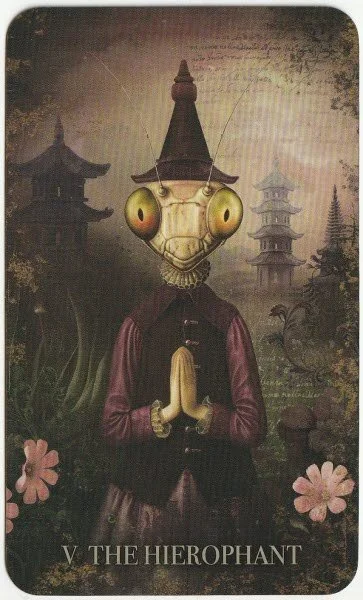
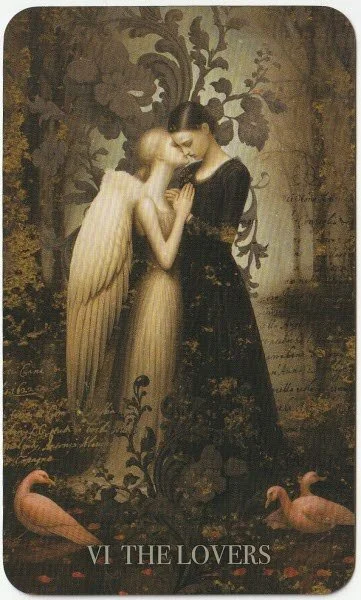
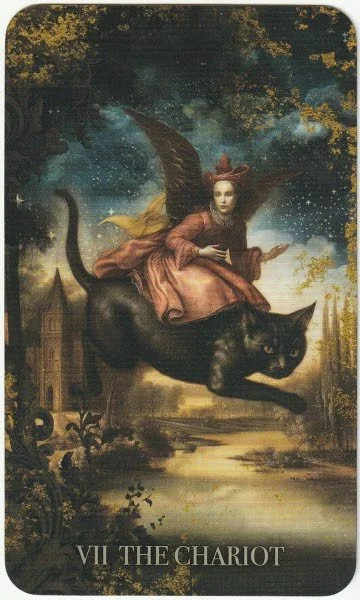
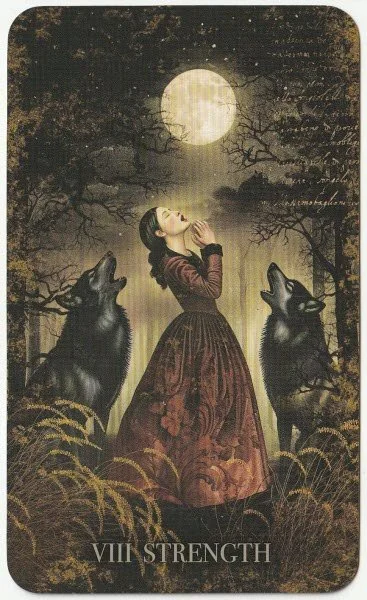
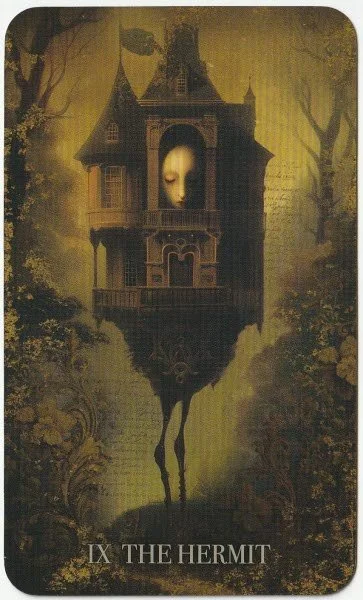
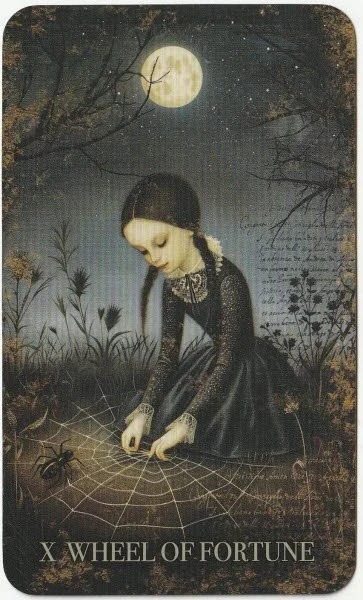
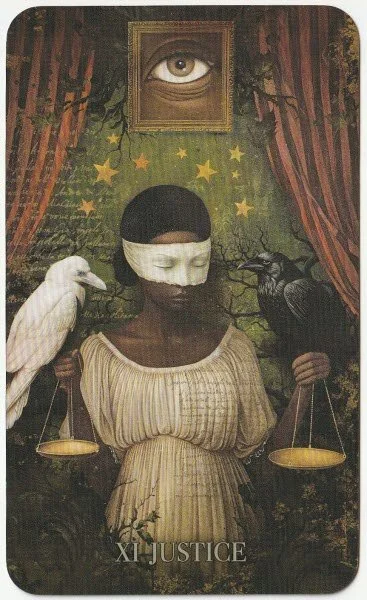
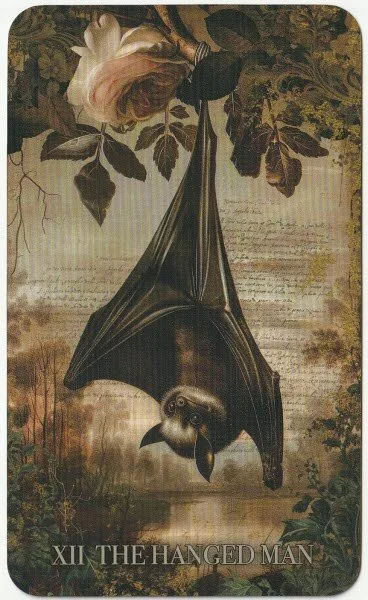
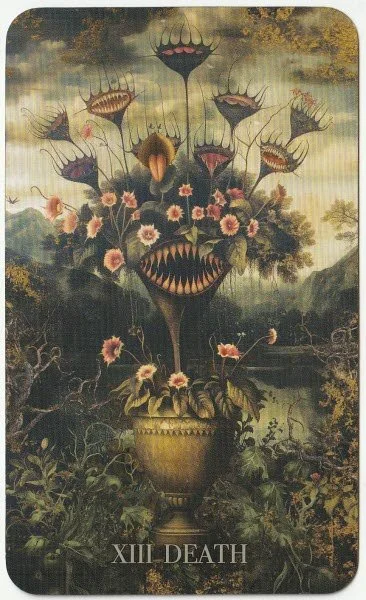
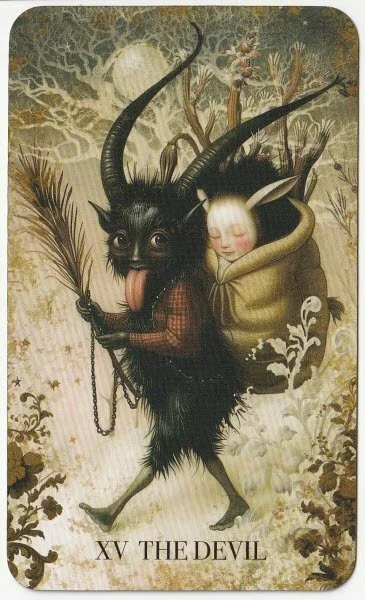
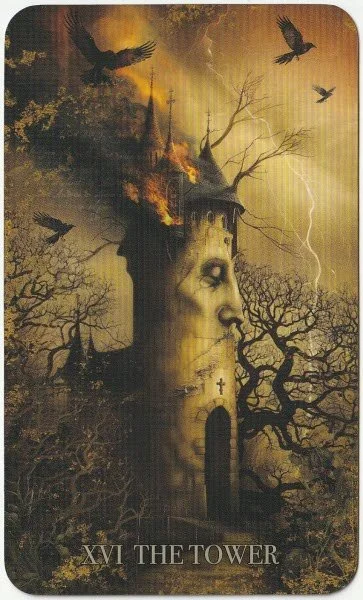
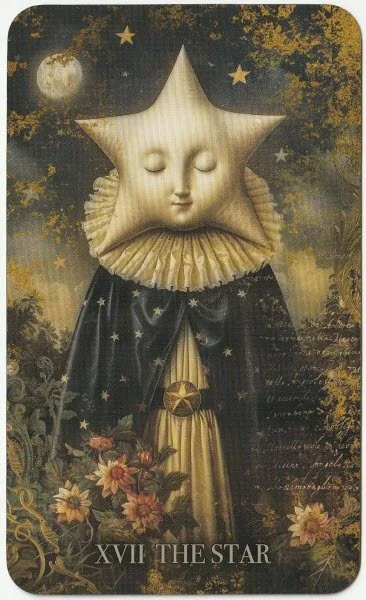
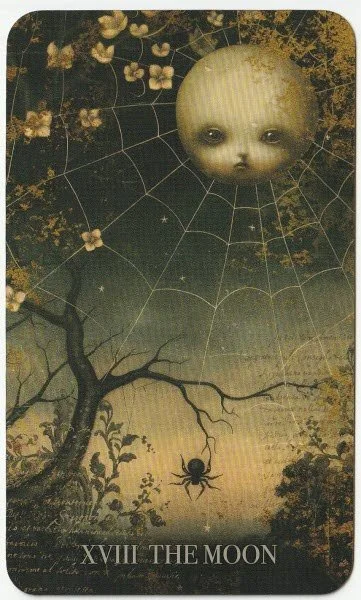
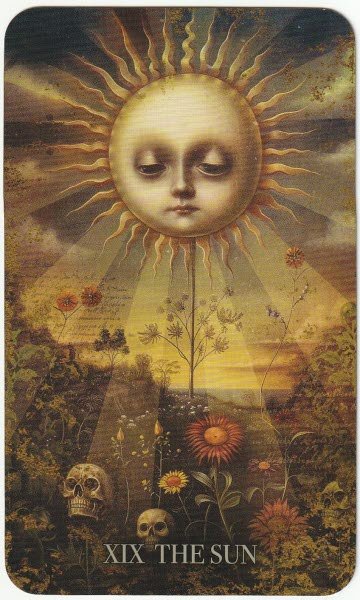
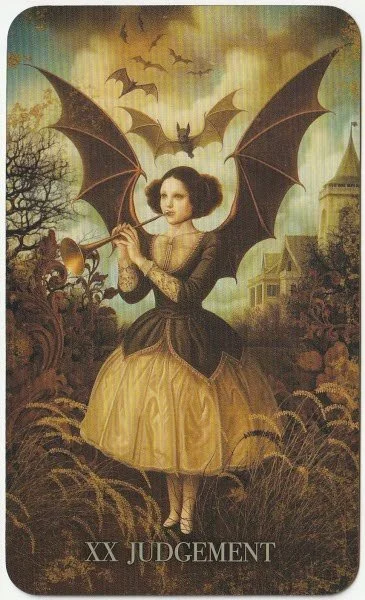
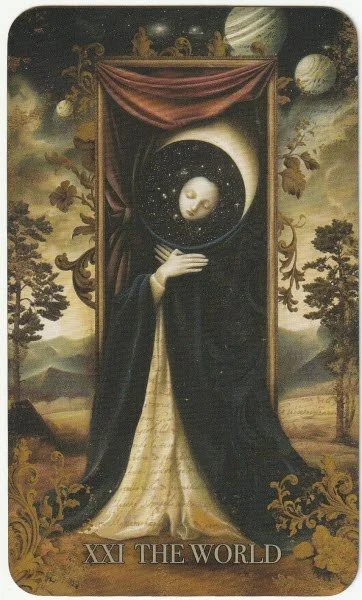
The major arcana are heavily illustrated, and I like many of the cards. The High Priestess is an interesting one because it pulls heavily on the theme of the underworld with the inclusion of the pomegranate and the snake. It pushes the interpretation beyond the usual ‘intuition’ and brings in a process of descent to retrieve something valuable. I was curious about The Lovers card, which depicts two women and wondered how the guidebook would handle the artwork. Disappointingly, it jumps straight to interpretation and leans heavily towards reciprocity and soul meeting soul, and how opposites can attract and create deep union. The only real opposition I can see in the artwork is the angel woman in white and the other woman wearing black. It’s a nice card, and one that would symbolise a deep friendship to me, but weirdly I can also see something about grief and healing. I love the Strength card — the woman howling up to the moon with two wolves is a very good interpretation of taming the beast within. The Hermit reminds me of Baba Yaga, but with a posh mini castle instead of a hut, and I quite like the connection there. The Wheel of Fortune is one of many cards that carry the theme of spiders or weaving. In this card, it’s a good symbolic nod to the three norns and their weaving of the past, present, and future. We see the web and the spider again in The Moon. The full moon is also visible in the Wheel of Fortune, but it has no face, whereas the moon card animates the moon with wide eyes and a tiny nose and mouth.
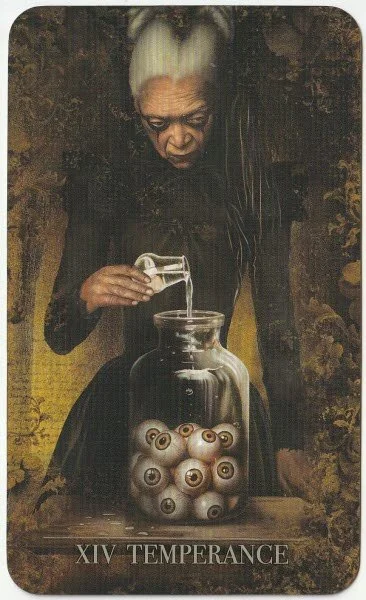
The card I am most intrigued by in the major arcana is Temperance. A crone-era woman stands with a table in front of her, and she’s pouring liquid from a small glass into an enormous jar half-full of eyeballs. The guidebook says, “Balance. A tempered space balancing inner and outer worlds. Ability to adapt. Divine flow. Healing energies. Harmony born from patience and trust in the slow alchemy of change. The calm in the eye of the storm. The slow unfolding. Temperance invites us to integrate opposites — light, shadow, work and rest, grief and joy — into wholeness. The appearance of grace. It asks for moderation and for the steady tending of the middle way. When this card appears, it reminds you that transformation is not rushed; it is brewed slowly, with nurturing. This is the embodiment of patience. True magic, it whispers, comes from surrendering to the sacred rhythm of becoming.” I don’t mind the artwork, but it just doesn’t work for the card's meaning. I’d have to really stretch it to associate the eyes with the visionary quality of Sagittarius — which is an association most won’t immediately reach for unless they know the astrological correlations of the cards. Maybe something else will come to me when I actually try and work with the cards, but for now, I’m struggling.
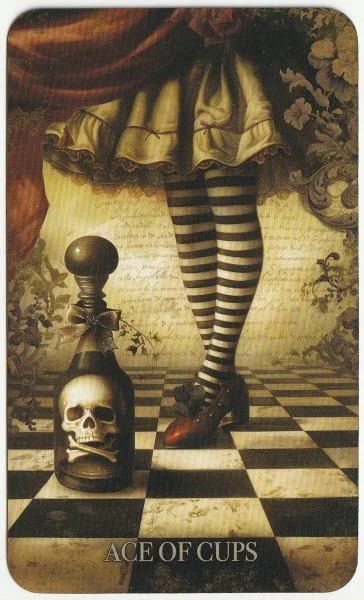
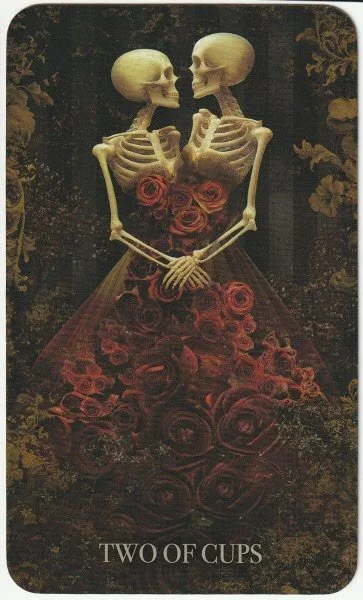
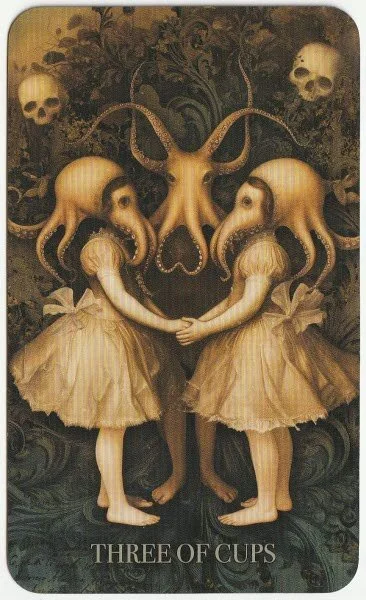
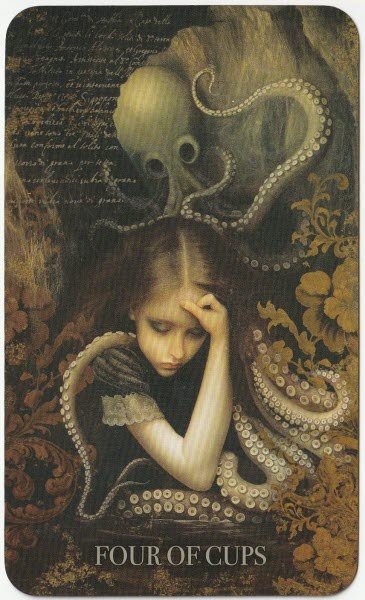
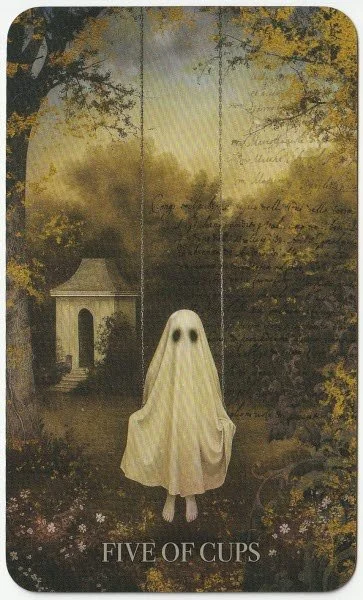
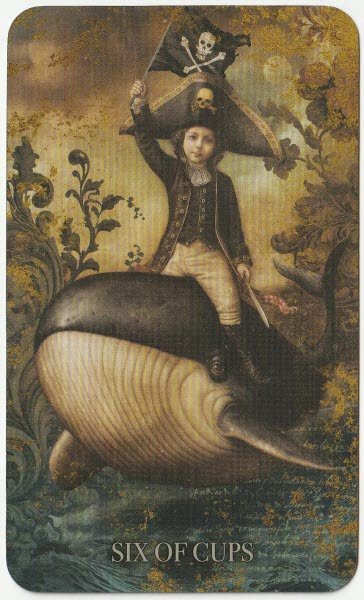
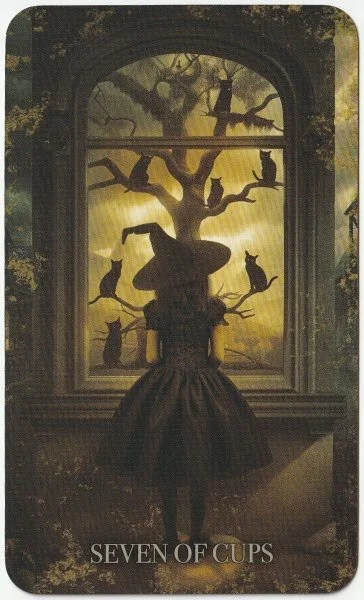
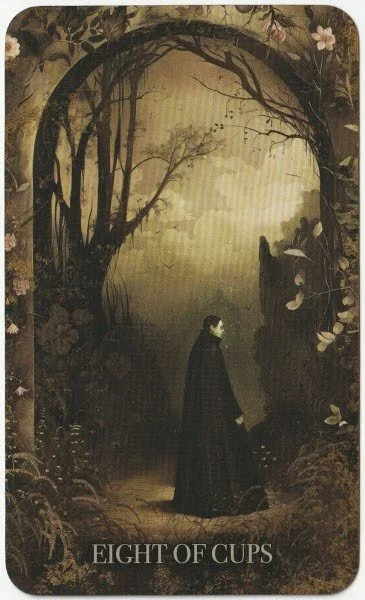
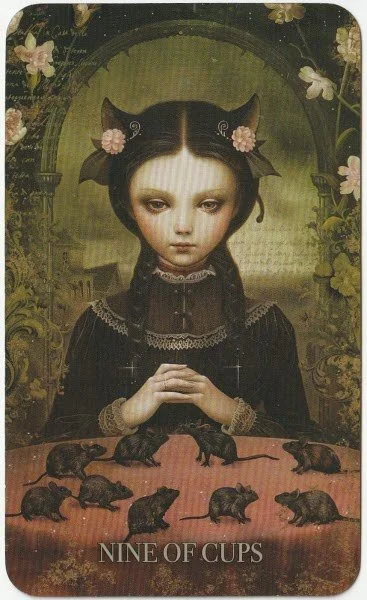
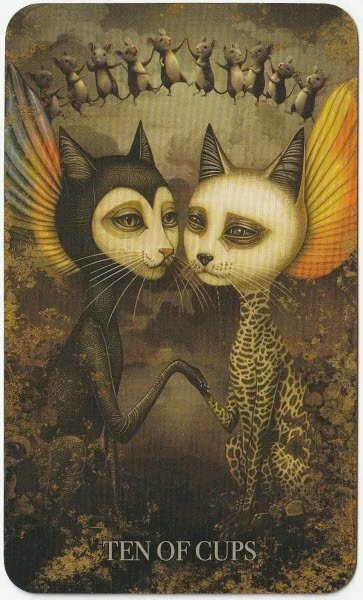
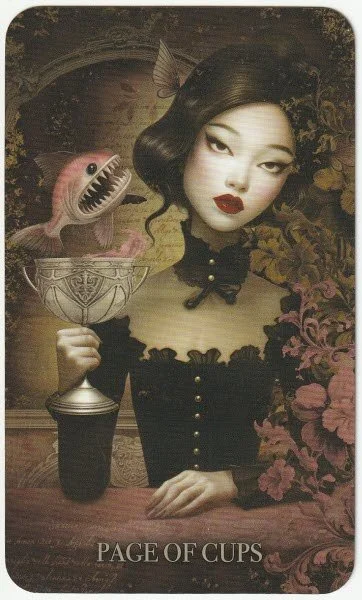
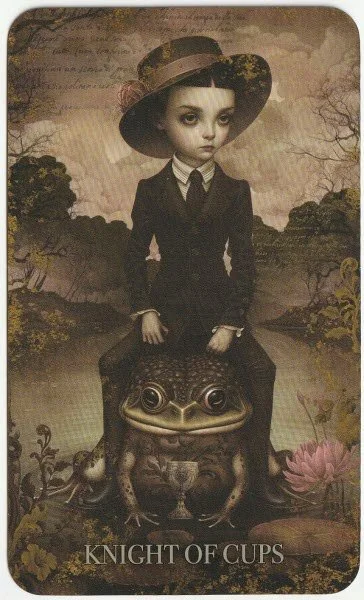
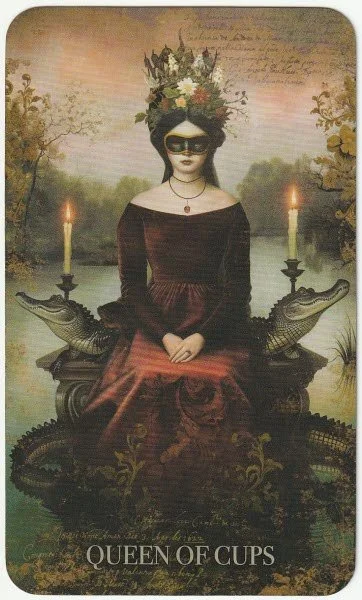
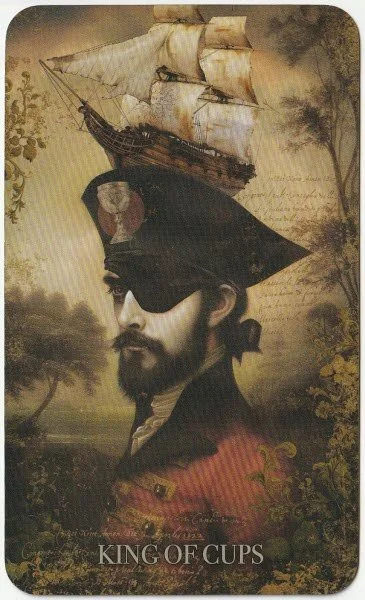
The Cups are a strong suit, and I honed in on my regulars to see if the deck lived up to its name. The Ace is giving me Alice in Wonderland vibes, and the bottle of poison on the chequered floor doesn’t exactly scream positive new beginnings on an emotional level. The guidebook is all about the good stuff, though, so the artwork in this instance isn’t exactly helpful. I actually prefer the message I get by looking at the symbols — but I’m an old cynic and enjoy an occasional honest-but-brutal reading. The Two of Cups is a nice mix of bone and roses, and it suggests the card can be read in several ways depending on the reader and the overall vibe. Is it til death do we part, or suggestive of something that is doomed to eventually die? I had a lovely surprise with the Three of Cups because it shows kids who all have the head of an octopus. It implies that emotions are deep, and as one of my symbols for the unconscious and hidden motivations, it’ll be interesting to see when it comes out in a reading. We have the octopus again in the Four, but the impression the card gives is totally different to the Three. We can see the melancholy in the girl’s face, and this time the octopus is behind her with some of its tentacles wrapped around her body. The Five of Cups threw me a little with its child dressed as a ghost sitting on a swing in an old garden. I immediately thought of the saying ‘Billy No-mates’ and can see how this correlates to the sense of loss and mourning of the past that is often present when this card appears. It really is a suit that keeps giving because in the Six of Cups, we have the child pirate riding a killer whale. His face is happy, and there is a confidence to how he’s holding his sword in the air. The Seven of Cups shifts the energy slightly with a darker tone, and instead of cups with different objects, we have a girl looking out of a window towards a tree full of black cats. I’d be inclined to read this a little differently from the standard interpretation because the artwork suggests there’s not actually that much difference between the options. The Eight of Cups is different again because it portrays a seriousness not seen in the other cards. It feels more grown-up with its Dracula-like figure standing next to a huge archway. I can understand the reference to transition easily enough, but he seems to be facing away from the archway — resistance to change perhaps, or avoiding a clearer pathway. It certainly doesn’t appear to be a clear-cut interpretation of moving on. Last one from this suit is the Knight of Cups, and I like that the androgynous figure is riding a frog. Symbolically, that’s a pretty rich description for this card.
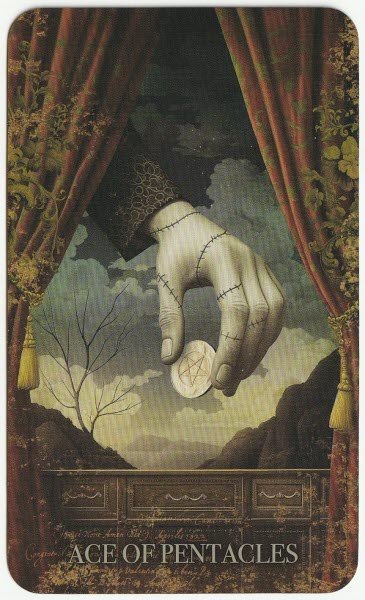
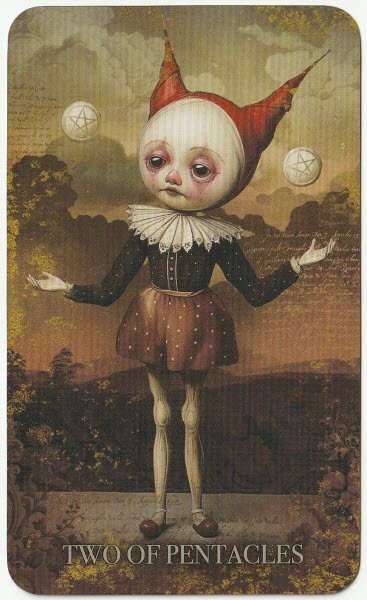
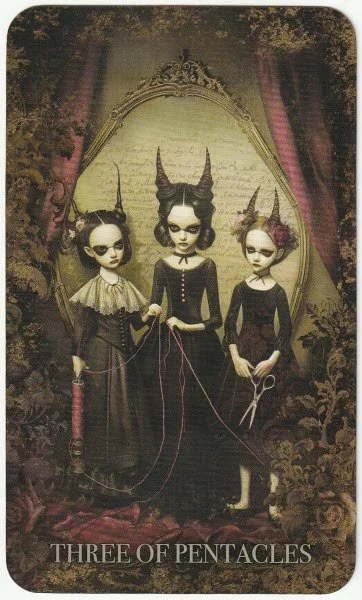
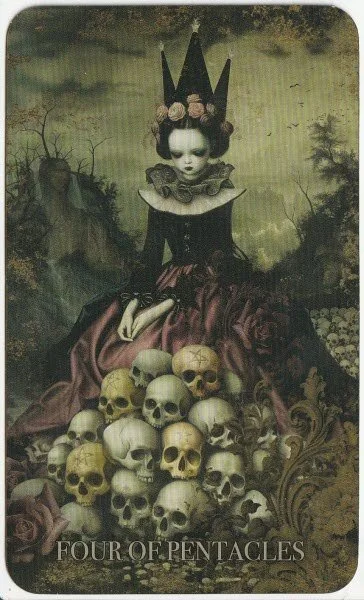
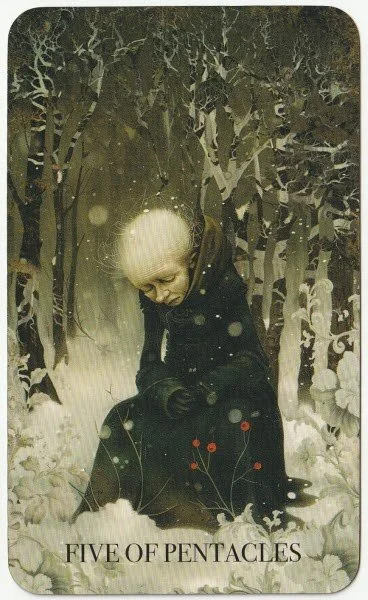
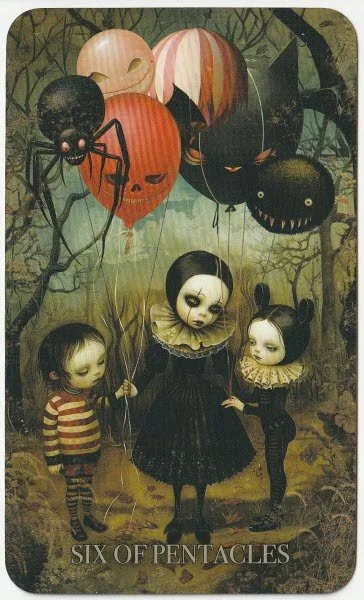
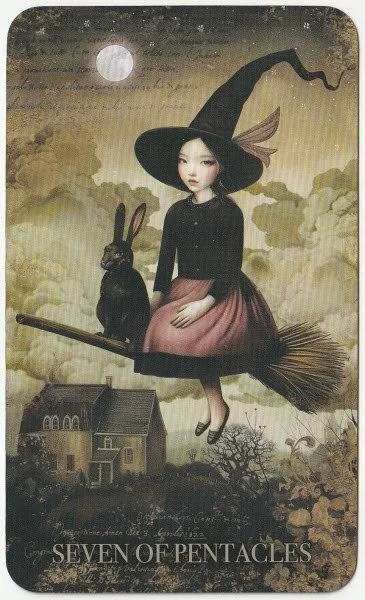
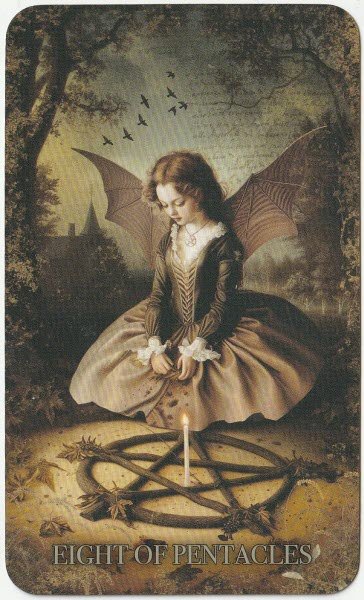
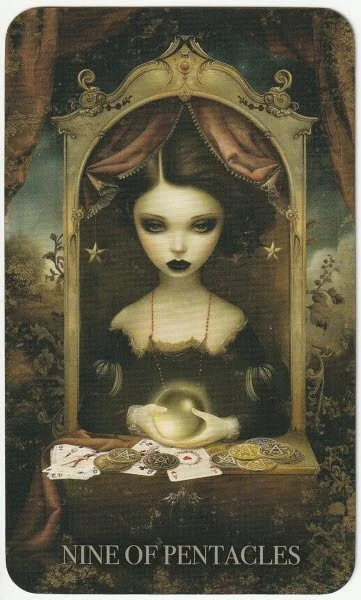
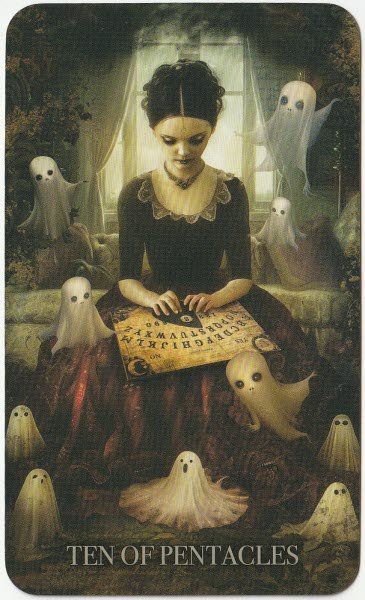
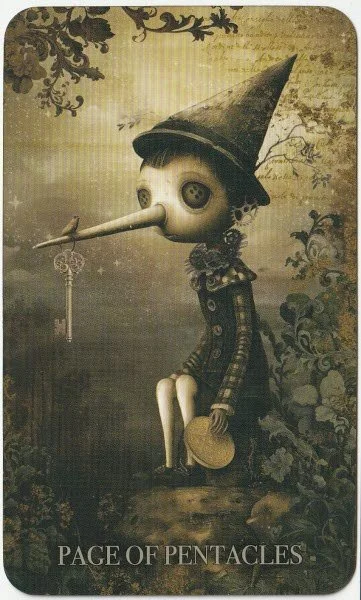
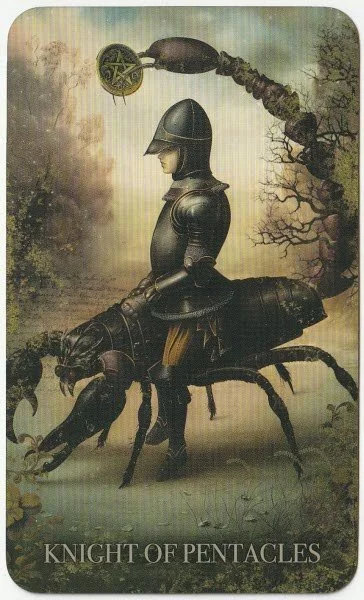
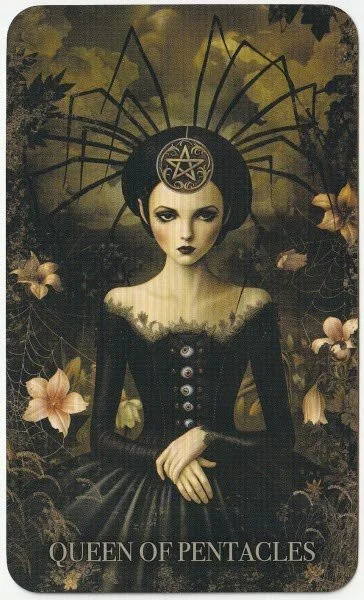
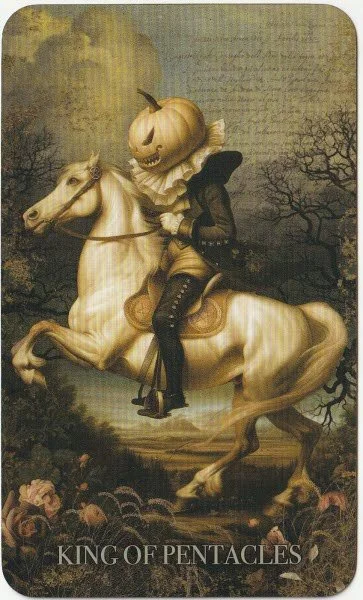
The Pentacles are often my least favourite in a deck because the Cups and Swords are usually where the complicated stuff sits, and therefore the imagery is better. That is not the case with the Grim Tales Tarot. The Four of Pentacles shows a young girl sitting with a pile of skulls, which is an odd depiction that could lead a reader down a bit of a rabbit hole. The Five of Pentacles stays with the theme of cold and alone, with its elderly figure crouched down in the snow. The figure is almost bald except for a few wispy strands, and the trees behind him are bare. Reassuringly, there are signs of life in the brilliant red flowers that are growing next to where he is sitting. I have no idea what the Seven of Pentacles is trying to say. I like the artwork, but I’m not sure how a young witch riding a broom with her black rabbit relates to the card’s meaning. Maybe it’s more about surveying the land? The Eight of Pentacles is a card that generally implies perfecting skills, learning, and being hard at work. Here we have a young winged girl sitting with a pentagram on the floor with a candle in the centre. The message here could be to work smarter, not harder. I love the Nine of Pentacles — a young girl is sitting in a booth with her tarot and crystal ball. I’ve often associated this card with self-employment and earning money with the skills and talents one has acquired. I think the artwork fits really well with that theme, especially with the coins on the counter. The one thing I find a little unnerving is that it doesn’t look like she has much space around her. The Ten of Pentacles goes straight to the point and literally shows a girl sitting with a Ouija board on her lap. Ten little ghosts are flying all around her, and it drives home the message that the past is somehow important here. An interesting point to note is the communication reference, as Crowley gave this card the astrological correlation of Mercury in Virgo. That’s a smart choice for the imagery. But I have absolutely no idea why the Page of Pentacles is Pinocchio. There is a key at the end of his nose, and a tiny bird is perched above where it hangs. Pinocchio has cogs for ears and buttons for eyes — but what’s the key for? I find the Knight of Pentacles similarly problematic because it’s a soldier riding a scorpion. It’s not a creature I would typically associate with the element of earth, but then I suppose they do live on land and hide under rocks.
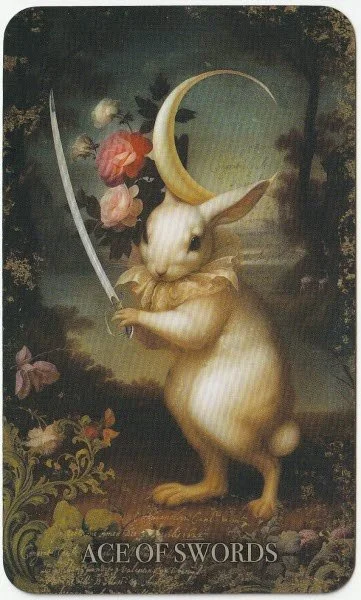
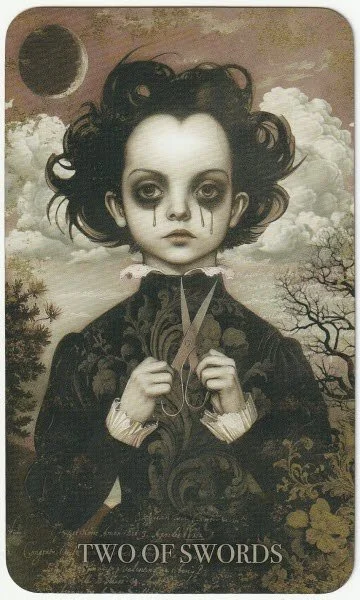
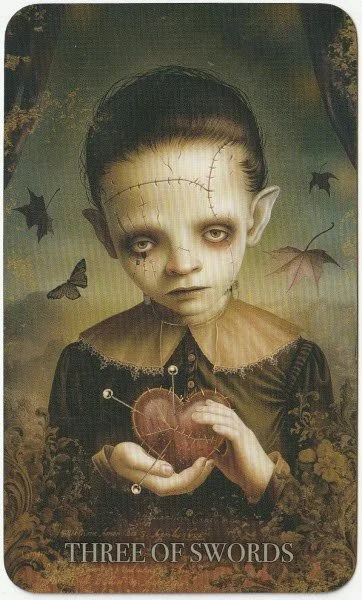
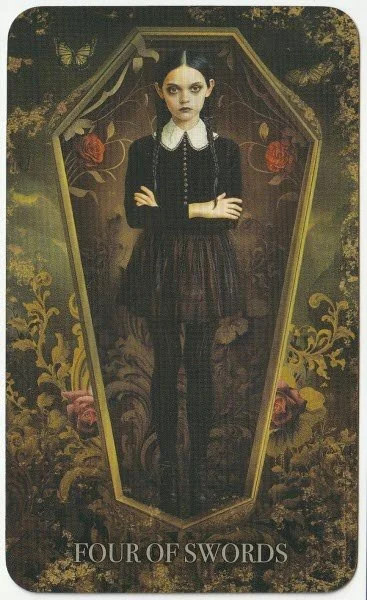
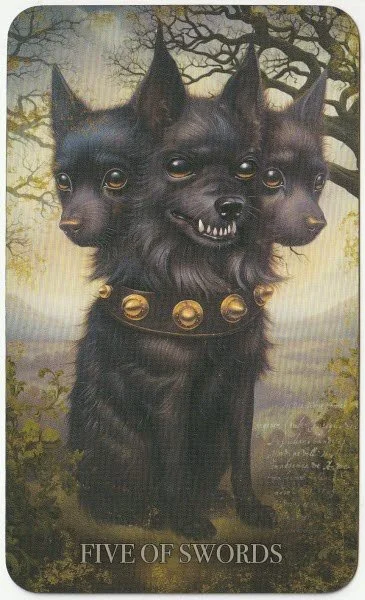
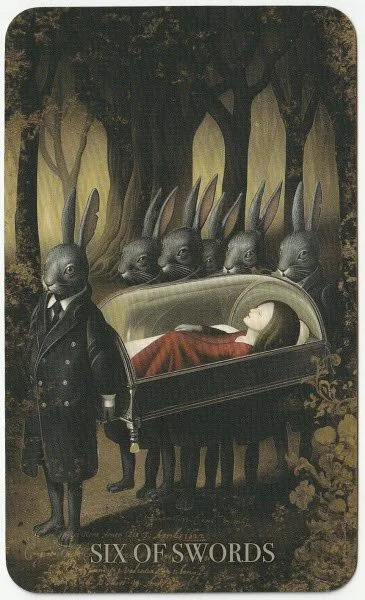
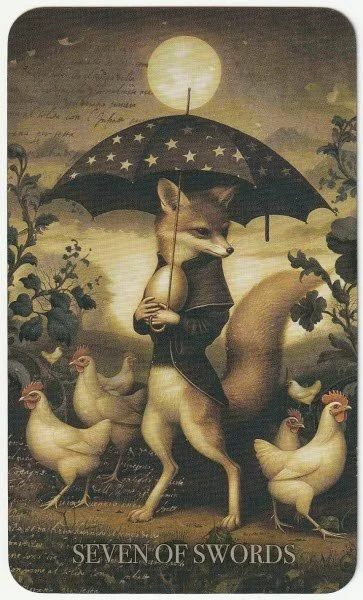
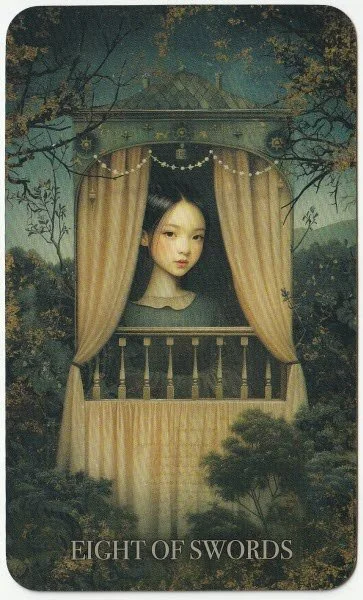
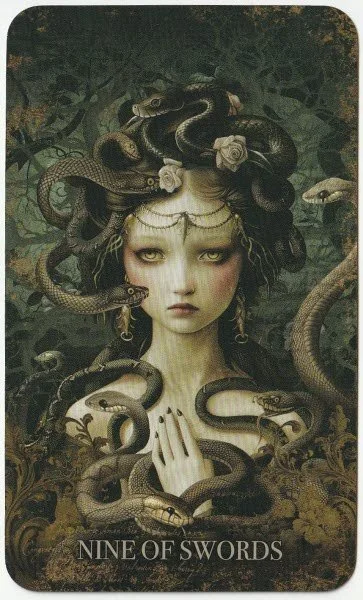
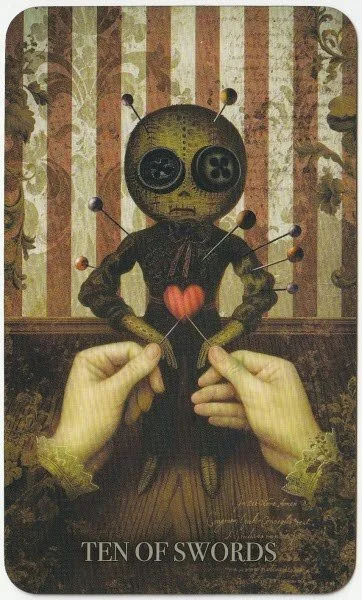
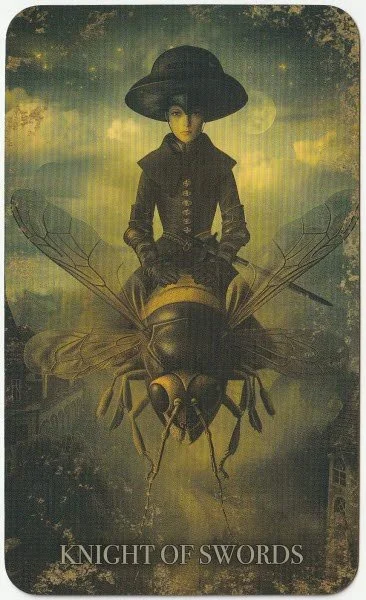
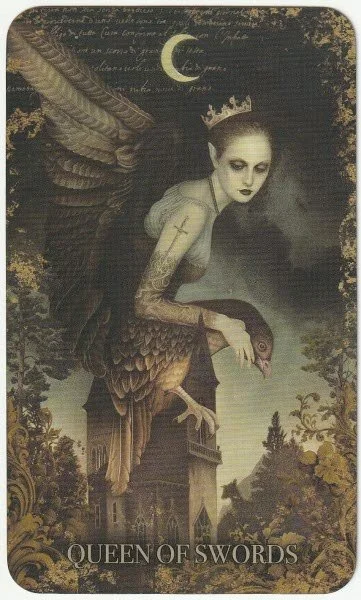
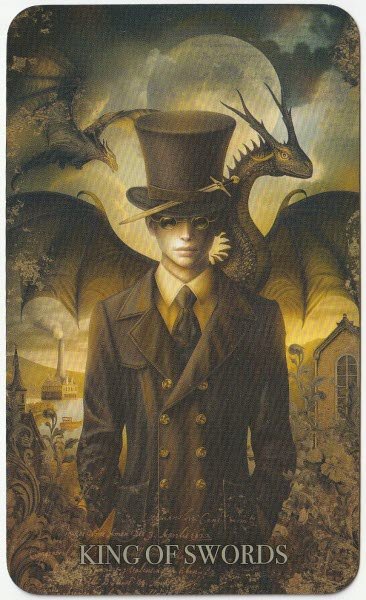
The Swords are another good suit, and I particularly like the Three of Swords with the artwork of a young Frankenstein-esque boy holding a heart that is pierced with three pins. It captures sadness and heartbreak, but the butterfly in the background also suggests life after a transformative struggle. The triple-headed dog in the Five of Swords took me a minute or two of contemplation to realise that I wasn’t going to get the connection in a month of Sundays. Cerberus guards the gates to the Underworld and, as such, isn’t an easy fit. I suppose there could be a link to picking your battles? Or maybe there is no way to get to the other side of a situation because you don’t belong there? I’m reaching here and may be missing an easy point. The Eight of Swords is easier to understand with a woman taking up all the space in a very small theatre. I would probably read this as main character syndrome, or making a performance out of being trapped when the performance is serving a weird unconscious need to be seen. I love Medusa, but not necessarily for the Nine of Swords. I can understand how that relates to having too many poisonous thoughts, but I think the myth is so much bigger than the card’s meaning. I’ve seen the voodoo doll used for Justice in another deck, The Dark Grimoire Tarot, and liked how it related to the theme of restoring balance and justice. Used for the Ten of Swords, it feels like it leans more towards vengeance and spite. The card can often symbolise betrayal and endings, but the signs are usually there beforehand, which raises the question of whether one should be blaming another person for one’s own refusal to take action at an earlier date.
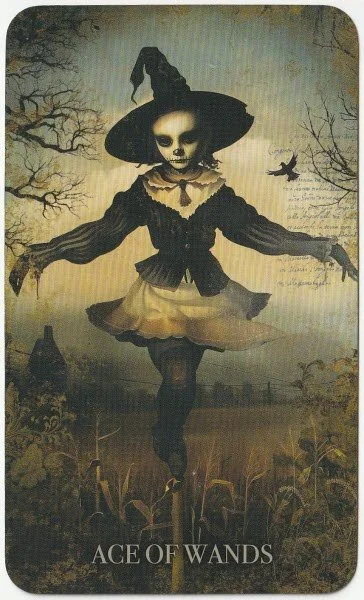
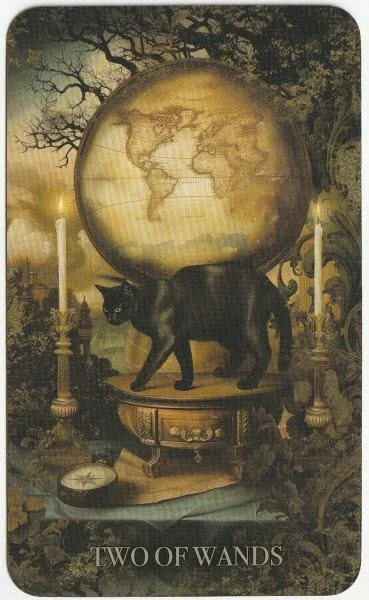
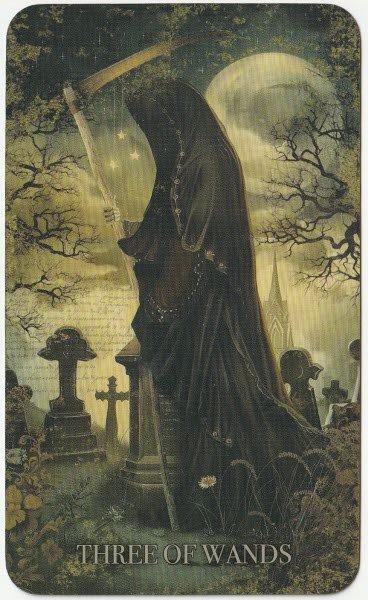
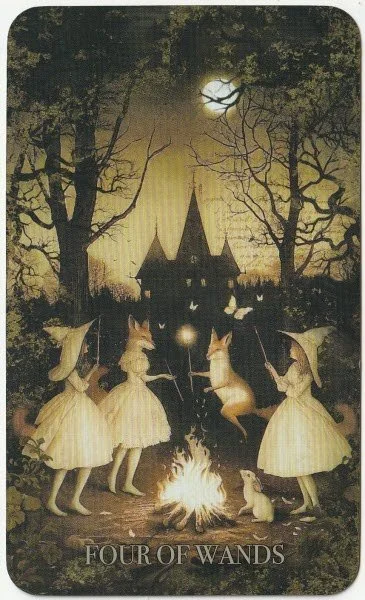
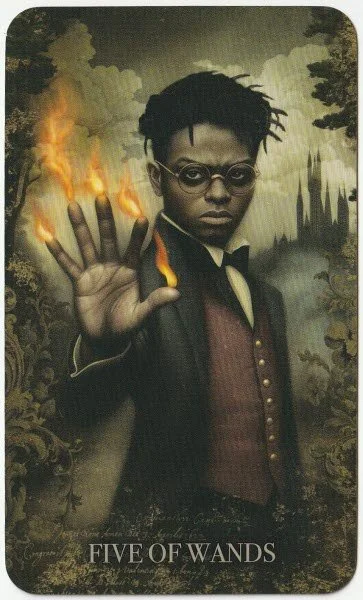
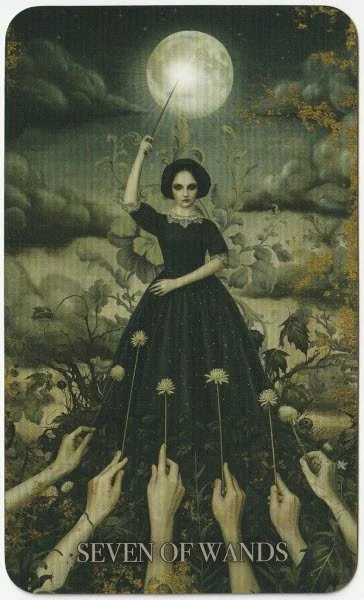
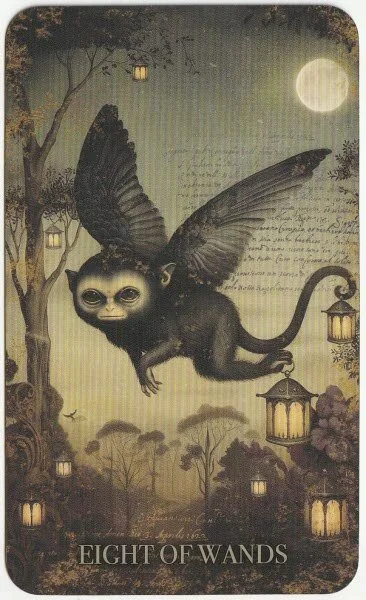
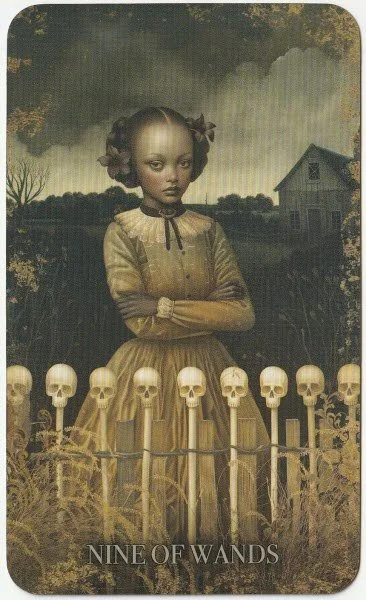
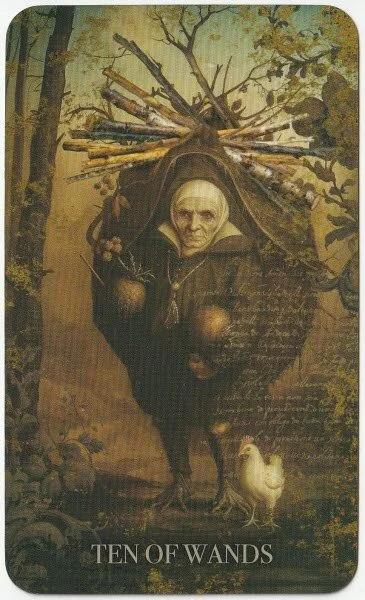
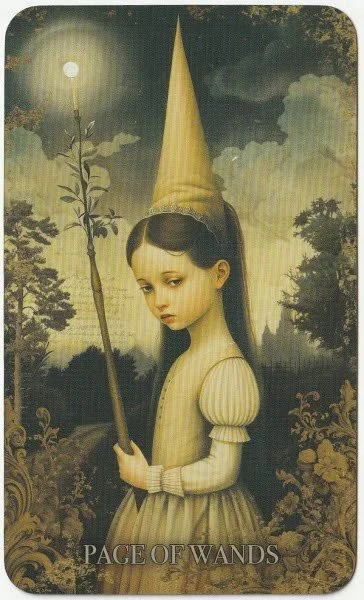
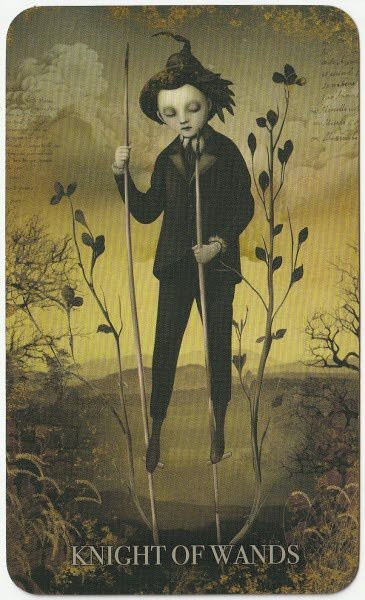
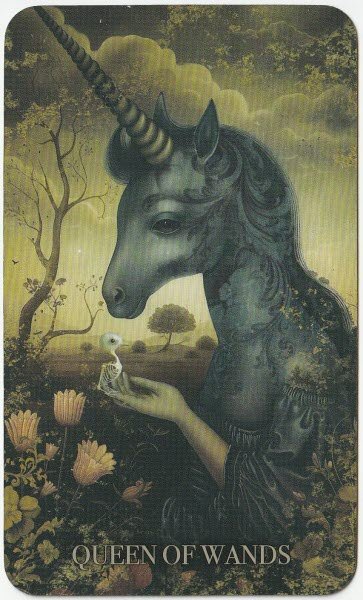
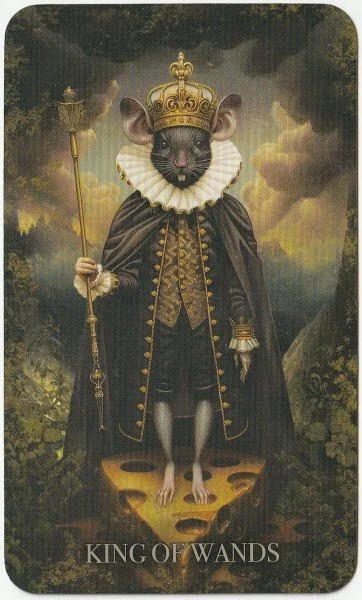
I like the Wands suit, although I find the figure in the Ace a bit complicated. Is she a scarecrow or a witch? It looks like she stood on a narrow post and is doing well to maintain her balance. I can see how there’s a connection to protecting seeds, but where’s the indication we’re dealing with the element of fire? The Two of Wands has a relatively straightforward message of letting intuition decide the direction of travel, but the Three throws me into complete chaos with the Grim Reaper patrolling the cemetery. It has me even more baffled than the Seven of Pentacles. The Nine of Wands is a little easier to read, and the young girl standing with her arms folded behind a fence topped with skulls definitely suggests a need for strong boundaries. The skulls hint at the possibility that this isn’t her first rodeo. The Ten of Wands is another good image, but interestingly, it’s another reference to Baba Yaga. The old woman has the legs of a chicken, and a proper chicken walks beside her. You can see she is carrying an enormous bundle of sticks on her back, and this is a pretty typical visual depiction of carrying burdens. And finally, the last card I want to mention is the Queen of Wands. Some of the court cards show human-like figures, but this one has the head of a unicorn. Is it a simple enough message that the person it portrays is quite rare in some way? Or maybe just unusual and a bit mythical. She has a human hand, and the skeleton of a bird is perched on her fingers — but, oddly, it looks alive. There could be a nod to tradition here, or to ancestry being significant.
Overall, I do like the deck and would be interested in using it when the situation feels appropriate. It feels like it would be best suited for a specific mission, rather than a deck for general reads. But if you engage in self-exploration, it could bring some unusual insights to light.
One small issue I have with the guidebook is the font on the taupe coloured pages — I understand the desire to indulge one’s creative leanings, but the low contrast between text and page makes it difficult to read unless you have good lighting. I would’ve also liked to see descriptions of the artwork and maybe a suggestion of how it relates to the card's meaning. I’m happy to look at card symbolism and take the cues, but some of the images are pretty complex and stray too far from the Rider-Waite interpretations. The guidebook stays close to traditional meanings, which is alright, but not helpful when the artwork is sometimes contradictory or confusing. I’ll probably ditch the book and rely on the artwork because I think it will make the reading more interesting. More complex, too, but great for digging underneath the palatable surface.
The AI Controversy
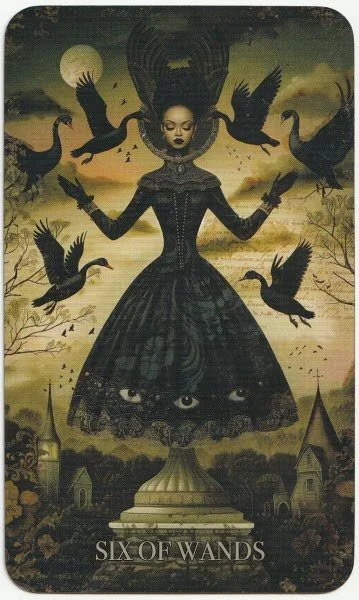
The artwork really isn’t bad, and while there are signs it’s AI-generated, I’m not particularly put off by knowing that and find it easy to connect with on the whole. I have a love of many different art styles and can recognise the influence of a few artists I admire. In no particular order: Christian Schloe, Catrin Welz-Stein, Ray Caesar, Nicoletta Ceccoli, and Maggie Taylor, to name but a few. There are also signs of famous faces like Rihanna (six of wands) and Wednesday Addams (four of swords). One of the main indicators that it could be AI is the drift in how human figures are drawn. There is a lack of consistency across the board with how figures are used to represent the different cards. Sometimes they’re children, sometimes they’re adults, and then in the court cards they are sometimes not even human. An artist will generally pick a theme and go with it through the entire deck. Drawing faces is hard, and while some artists are capable of drawing different styles, they all have their preference as to how they draw faces. There are too many styles in here — even for someone used to using digital art. If you look at the artists’ work I mentioned, you can usually tell it’s their work because of the features in the faces of their characters. They’re distinctive; more importantly, they’re consistent.
The Grim Tales Tarot is cohesive enough so that it doesn’t feel jarring to look through the cards, but that may largely be down to the consistency of the colour palette and other symbols and motifs that run through the deck. It’s definitely on the dark side, and it doesn’t fail nor disappoint in that department.
Another potential tell that the ‘artist’ had generative help is actually the Pentacles and Wands. I have an awful lot of decks and have clearly reviewed more than a handful — it is very normal to find I like one or two suits more than the others, but this deck had lots of interesting things in all four. This has always made sense to me because most of us have cards we are drawn to at any given moment. For artists to show more energy through the cups (emotion) and swords (thoughts) is completely understandable. Readings that focus on the Wands (spiritual) can be boring, even though they relate to the element of fire. Pentacles can also be dull because they relate to material matters. Most people coming for a reading have emotional stuff going on, or they’re in a situationship that is doing their head in — it’s not hard to see how that translates into artwork. Most artists creating art for tarot are connecting with the theme of the card, and when it’s a bottom-up process, it hits different. AI is all about the word cues, not the feels.
If Fiona has used AI extensively, it’s clearly drawn from the work of the artists I mentioned earlier, and maybe others too. But she’s still chosen some good representations even if she did, and I’m fairly sure she at least had knowledge of the astrological correlations as well as a pretty good understanding of what the cards are supposed to mean. This is not the space to get caught up in the argument about the ethics of AI and generative art, but I am likely to write a post about AI decks in general in the near future. I find it interesting that one of the strongest themes running through the deck is that of weaving and spider webs. It makes me think of the story of Arachne and how she dared to declare herself better at weaving than the goddess Athena. In Ovid’s version, a competition ensues, and while Arachne technically won the contest, Athena trashed her work out of spite and jealousy. Arachne ended up at the end of a rope, and Athena turned her into a spider so she could carry on weaving. I never did quite know whether to see the outcome as a blessing or a curse. Spiders don’t generally get to weave elaborate scenes, and being compelled to weave the same pattern doesn’t seem befitting for a skilled artisan.
After reading a few comments from people who bought the deck without knowing it had AI-generated imagery, there does seem to be a relatively strong rejection of the finished product for that reason alone. People have to do what they feel is right, but I don’t personally reject AI as a tool. And honestly, if it was created with AI, I can’t begin to imagine what it’ll be capable of a few years from now.
Recent Posts





Archives
Categories
- AI Decks
- Animal-centred
- Books
- Decks For Self-development
- Difficult Decks
- Expensive Decks
- Lenormand Decks
- Oracle Cards
- Oracle Cards For Beginners
- Out-of-print
- Personal Favourites
- Published 2000s
- Published 2010s
- Published 2020s
- Tarot
- Tarot & Oracle Sets
- Tarot Cards For Beginners
- Under £15
- Under £20
- Under £30
- Under £40
- Witchy Decks
- Woman-centred

Details for the tarot and oracle giveaway for September 2026.